
EMR'26, "Modelling and control using EMR, application to HEVs and others"
EMR'26 Summer School, Modena (Italy), co-organized by University of Modena and Reggio Emilia (Italy) and University of Lille (France), 1-3 July 2026
Welcome on the EMR (Energetic Macroscopic Representation) official website. It contains all EMR presentations (including those of EMR summer schools), references, users, libraries and the latest news.
EMR, definition and interest
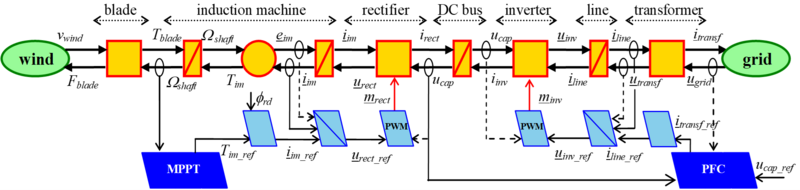
Energetic Macroscopic Representation (EMR) is a graphical formalism for the organization of models and controls of energy conversion systems. EMR is based on the interaction principle of Systemics and the causality principle of Energy. EMR leads to control schemes (blue) by a systematic inversion of the model organization (orange).
EMR in academia or industry
EMR is taught in Canada (Univ. Sherbrook, Univ. Quebec Trois-Riviere), China (Harbin Inst.Tech., Tsinghua Univ.), Vietnam (Hanoi Univ. of Science & Tech.y), Swizerland (Univ. of Applied Sience of Valais-Wallis, CERN), Portugal (INES Coimbria), Spain (Univ. Polytec. Catalyuna, Univ. Cralos III of Madrid), Austria (Tech. Univ. Graz), Colombia (Santander Univ.), Romania (Cluj-Napoca), India (Amity Univ.) and many French universities, etc. In industry, EMR is used by ALSTOM, SIEMENS mobility, SIEMENS Software, SNCF, Stelanatis (ex PSA), VALEO, RENAULT, Sherpa Engineering, TYPHOON, etc.
EMR, brief history
EMR has been introduced in 2000 for research development in complex electromechanical drives. EMR has been extended to any energy conversion systems in 2010. EMR pictograms are developed in various sofwares to facilitate its usage (MATLAB-Simulink, AMESIM, PSIM, TYPHOON HiL, etc.).
Summer schools are regularly organized to show the help provided by EMR for the control development of complex systems in all physical domains, particularly in the field of electrified systems (electric vehicles, hybrid electric vehicles, trains, etc.). These summer schools started since 2006 in Lille (France, 2006), then, Harbin (China, 2008), Trois-Rivières (Canada, 2009), Lausanne (Switzerland, 2011), Madrid (Spain, 2012), Lille (France, 2013), Coimbra (Portugal, 2014), Lille (France, 2015), Montréal (Canada, 2016), Lille (France, 2017), Hanoi (Vietnam, 2018) and Lille (France 2019). The edition 2020 (Oviedo, Spain) has been cancelled due to the COVID-19 crisis. Then EMR came back to a regular organisation but in hybrid mode: Lille (France, 2021), Sion (Switzerland, 2022), Lille (France, 2023), Delhi (India, 2024) and Lille (2025). The next edition will be held in Novi Sad (Serbia) in july 2026. These Summer School are dedicated to Master and PhD students, engineers and scientists, from both academia and industry, which have to model and control new multi-physical systems such as industrial multi-drive systems, traction and propulsion systems, hybrid electric vehicles, or renewable energy generation systems.
EMR in European projects
EMR has been at the core the European project H2020 RIA PANDA (2018-2022). This project is based on the EMR formalism to organize all the simulation models (https://project-panda.eu/). This project was coordinated by Prof. Alain Bouscayrol (University of Lille).
EMR is nowaday used in the Europena projects HE RIA CODE4V (2024-2027) and MSCA SE DETROIT (2026-2030). Both are focused on SDV (Software Defined Vehicles) and EMR contribute to develop SDV function from Model-In-the-Loop to Driver-In-the-Loop testing.


Contact
Alain BOUSCAYROL, Alain.Bouscayroluniv-lillefr
L2EP / University of Lille - 59 655 Villeneuve d'Asq cedex, France
Tel : +33 3 20 43 42 35 | Fax : +33 3 20 43 69 67
Webmaster
Ryan O’BERRIEL & Alain BOUSCAYROL (L2EP, Univ. Lille – France)