
EMR 2026
EMR'26 | photos |
Modelling and control using EMR, application to HEVs and others

Summer School of University of Modena and Reggio Emilia (Italy) and University of Lille (France)
Download the EMR’26 flyer in PDF
The 18th EMR (Energetic Macroscopic Representation) international summer school is jointly organized by University of Modena and Reggio Emilia (Italy) and University of Lille (France) from the 1st to 3rd of July 2026 in Modena in hybrid mode . EMR’26 is supported by scientific organizations (IEEE-VTS, MEGEVH, CUMIN, L2EP)
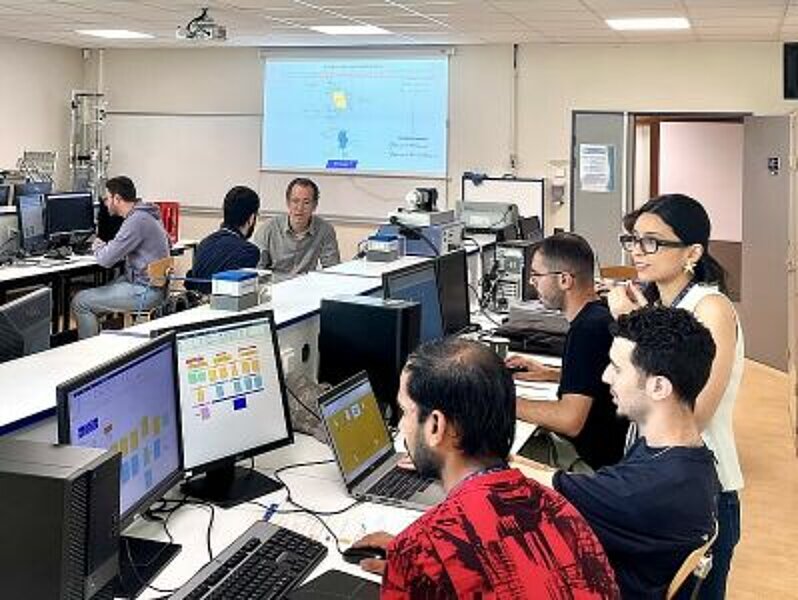
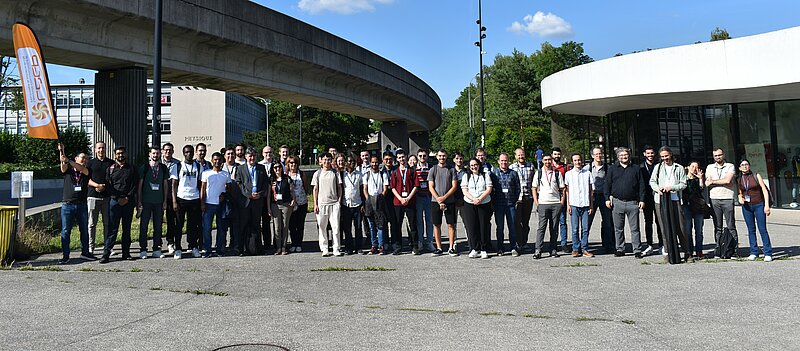
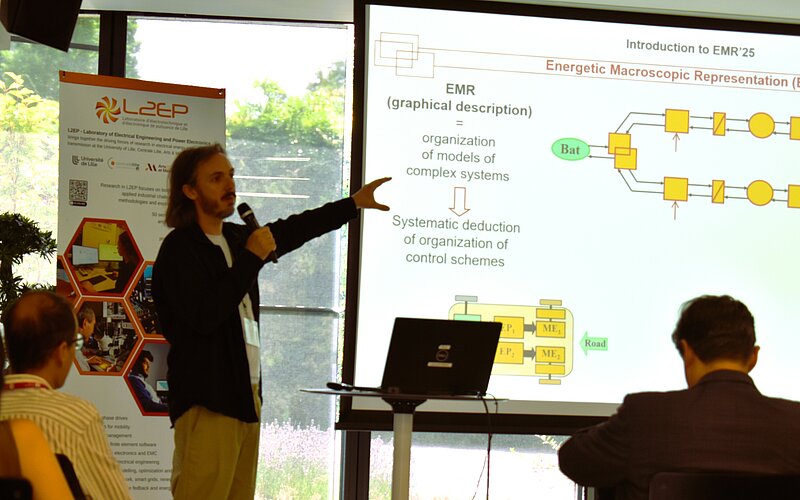
EMR'25, Lille, France (more photos)
Presentation
This workshop is focused on the Energetic Macroscopic Representation (EMR) methodology for modelling and control of complex electromechanical systems.
EMR is a graphical formalism that was introduced in 2000 to describe complex electromechanical systems. EMR has since been extended to complex multi-physical systems (thermal science, electrochemistry, fluid mechanics …). EMR is based on the action-reaction principle to organize the interconnection of models of sub-systems according to the physical causality (i.e. integral causality). This description highlights energetic properties of the system (energy accumulation, conversion and distribution). Moreover, an inversion-based control can be systematically deduced from EMR using specific inversion rules.
Compared with other graphical description, such as Bond Graphs or Causal Ordering Graphs (COG), EMR has a more global energetic view and contributes to system’s control design. It differs from structural description tools such as Physic Modelling Language (PML) using Object-Oriented Modelling Language, which makes its libraries to be coupled in the same way as physical units. EMR is focused on the system function and not only on the system structure. EMR gives insights into the real energy operation of systems and allows a deep understanding of its potentialities from a dynamic point of view.
In short, the distinct features of EMR lie in its clarity of physical concepts, as well as their physical causality, and its functional description rather than a structural description. It hence contributes significantly to the design of control and energy management of systems.
Summer School
This Summer School is aimed at Master and PhD students, Engineers and scientists, from both academia and industry, who have to model and control new multi-physical systems such as industrial multi-drive systems, traction and propulsion systems, hybrid electric vehicles, or renewable energy generation systems.
Chair
Dr. Davide TEBALDI, General chair of EMR'26 (Department of Engineering Enzo Ferrari,, Univ. Modena & Reggio Emilia, Italy)
Co-Chair
Prof. Alain BOUSCAYROL - Co-Chair of EMR'26 (Univ. Lille, L2EP, CUMIN, IEEE-VTS, France)
co-chair

Pr. Roberto ZANASI, co-chair of EMR'26 (Department of Engineering Enzo Ferrari,, Univ. Modena & Reggio Emilia, Italy)
Location
Venue
Department of Engineering “Enzo Ferrari” (DIEF),
University of Modena and Reggio Emilia.
Via P. Vivarelli, 10, 41125, Modena, Italy
Regsitraton and Lunches - to be determined
Lectures – MO-52 building (Tecnopolo Modena)
Simulation – MO-25 building
How to reach the venue ?
By plane: Bologna Airport is about 40 km from DIEF. Reach Bologna railway station by taxi or local bus, then follow the next step “By train”.
Alternatively, take the shuttle bus connecting the airport to Modena. Get off at the terminus, the coach/bus station, then continue by bus using lines 7, 2, or 9/9A:
Line 7, destination Gottardi: departure from the coach/bus station stop; arrival at the stop near the department car park.
Line 2, destination S. Damaso: departure from the coach/bus station stop; arrival at the stop on Via Vignolese.
Line 9/9A, destination Gottardi: departure from the coach/bus station stop; arrival at the stop near the department car park.
By train: Check the railway timetable. The local bus connection between the railway station and DIEF is described in the “By bus” section.
By car, via A1 motorway: Exit at Modena Sud. After the toll booth, turn right onto Strada Vignolese and continue straight for about 10 km. After that, at the roundabout junction with the Modena ring road, take the second exit to continue on Strada Vignolese. After 450 meters, turn right to Via Gelmini, then turn left to Via P. Vivarelli.
By bus, local bus service: Two lines connect the coach/bus station and the railway station to the DIEF site:
Line 7, destination Gottardi: departure from the coach/bus station stop; arrival at the stop near the department car park.
Line 9/9A, destination Gottardi: departure from the coach/bus station stop; arrival at the stop near the department car park.
From the coach/bus station, you can also take line 2, destination S. Damaso: departure from the coach/bus station stop; arrival at the stop on Via Vignolese.
For more information, please consult the SETA service website.